

In July of 2025, a Medium post entitled “My Experience Inside Soryu Forall’s Monastic Academy” was made making false claims about our teacher, Soryu Forall. The author of this post is Harrison O’Connor, also known as Satoru.
Harrison has hidden all comments on his post, including a number of comments in support of Soryu Forall and MAPLE.
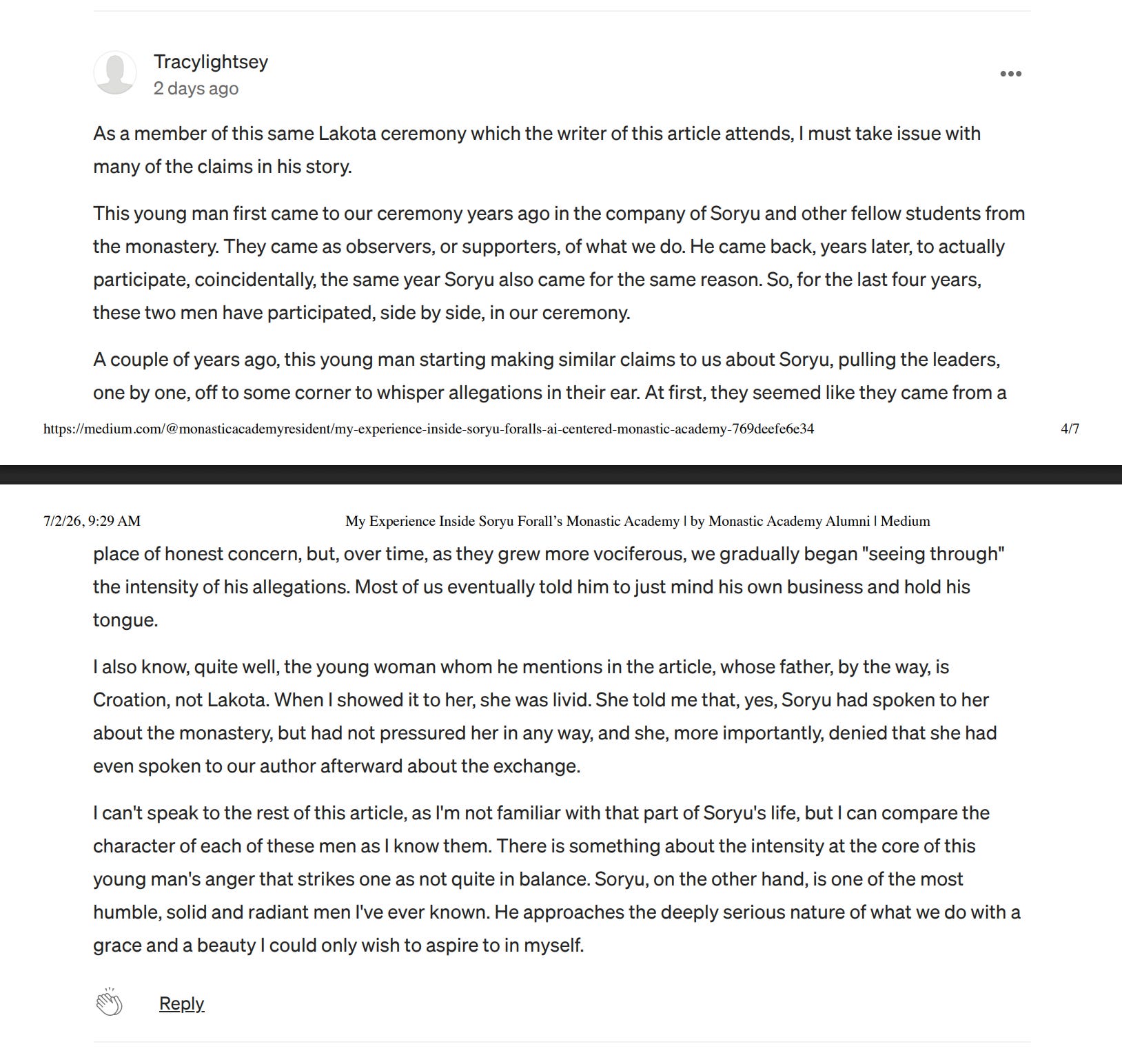
We reached out to the author of one of these comments and he agreed to us sharing it here:
As a member of this same Lakota ceremony which the writer of this article attends, I must take issue with many of the claims in his story.
This young man first came to our ceremony years ago in the company of Soryu and other fellow students from the monastery. They came as observers, or supporters, of what we do. He came back, years later, to actually participate, coincidentally, the same year Soryu also came for the same reason. So, for the last four years, these two men have participated, side by side, in our ceremony.
A couple of years ago, this young man starting making similar claims to us about Soryu, pulling the leaders, one by one, off to some corner to whisper allegations in their ear. At first, they seemed like they came from a place of honest concern, but, over time, as they grew more vociferous, we gradually began “seeing through” the intensity of his allegations. Most of us eventually told him to just mind his own business and hold his tongue.
I also know, quite well, the young woman whom he mentions in the article, whose father, by the way, is Croation, not Lakota. When I showed it to her, she was livid. She told me that, yes, Soryu had spoken to her about the monastery, but had not pressured her in any way, and she, more importantly, denied that she had even spoken to our author afterward about the exchange.
I can’t speak to the rest of this article, as I’m not familiar with that part of Soryu’s life, but I can compare the character of each of these men as I know them. There is something about the intensity at the core of this young man’s anger that strikes one as not quite in balance. Soryu, on the other hand, is one of the most humble, solid and radiant men I’ve ever known. He approaches the deeply serious nature of what we do with a grace and a beauty I could only wish to aspire to in myself.
Tracylightsey
Here is a screenshot of the original comment:
The Buddha taught that "bad dharma" (akusala dhamma, or unwholesome states/qualities)refers to thoughts, intentions, and mental states that lead to personal suffering and cause harm to others. In Buddhist psychology, these states cloud the mind and bind individuals closer to the cycle of samsara(suffering and rebirth).
The Root Causes of Akusala Dhamma
Every unwholesome state stems from the Three Poisons (trivisa), which act as the root of all negative karma:
Greed / Attachment (lobha): Craving, selfishness, and clinging to desires.
Hatred / Aversion (dosa): Anger, ill-will, resentment, and rejection of reality.
Delusion / Ignorance (moha): Misunderstanding the true nature of reality, specifically impermanence (anicca) and non-self (anatta).
Characteristics of Unwholesome States
The Buddha used specific criteria to identify whether a mental state or action is akusala:
Blameworthy: They are criticized by the wise and those who are spiritually developed.
Pain-producing: They naturally result in mental agitation, anxiety, or future suffering (dukkha).
Obstructive: They hinder mental clarity, preventing progress in meditation and mindfulness.